
Custom Online Laser Hardening
CipherFab offers precision laser surface hardening services using advanced fibre and diode laser systems to selectively increase surface hardness and wear resistance on critical metal components. This localized heat-treatment process delivers high hardness, minimal distortion, precise control, and superior performance for complex geometries, gear teeth, grooves, and functional surfaces.
CipherFAB values your privacy and security. Learn More
Get an Instant Custom Online Laser Hardening Quote
Upload your CAD FilesSupported files: STEP, STP, SLDPRT, DXF, IPT, PRT, SAT
Laser Hardening Service
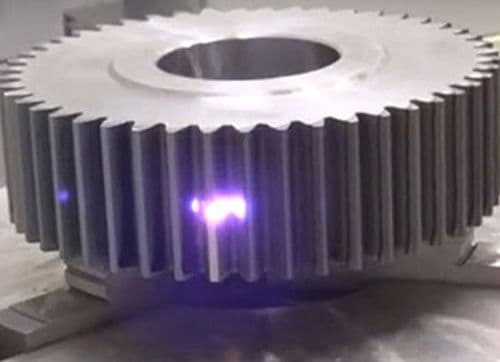
CipherFab offers a high-quality laser surface hardening service using high-power diode and fibre lasers to selectively harden specific functional surfaces on metal components — without bulk heating, without quench media, and without the dimensional distortion that conventional induction or case hardening introduces. Laser hardening is suitable for applications that require high hardness with relatively shallow case depth on selected surface areas, with no dimensional distortion — and it can be used for geometries with irregular shapes, grooves, lines, and gear teeth. CipherFab provides instant quotes on laser hardened components with DFM feedback on every uploaded file. Xometry
Recommended Materials for Laser Hardening
Materials supported for this capability.
Laser Hardening
Laser hardening requires materials with sufficient carbon content (≥ 0.2% C) to enable martensitic transformation.
- Carbon & Alloy Steels Medium Carbon Steel 1045 (0.45% C)
- High Carbon Steel 1080
- Alloy Steel 4140 (0.40% C)
- Alloy Steel 4340
- AISI 4130 (0.30% C)
- AISI 1060 / 1070 spring steel
- Tool Steels Tool Steel D2 (1.55% C — high response to laser hardening)
- Tool Steel H13 (die and mould hardening)
- Tool Steel O1
- Tool Steel A2
- Tool Steel S7
- Cast Iron Grey Cast Iron (EN-GJL)
- Ductile Cast Iron (EN-GJS-600) — bearing surfaces, cylinder bores, and wear faces
- Stainless Steel Stainless Steel 410 (martensitic grade — hardenable)
- Stainless Steel 420
- Stainless Steel 440C (highest hardness of any stainless — 58–60 HRC achievable)
Tolerance Standards for Laser Hardening
General tolerance information for this capability.
Laser Hardening
| Description | General Tolerance |
|---|---|
| Hardness Achieved | 58–64 HRC on high-carbon tool steel; 52–58 HRC on alloy steels; 40–50 HRC on medium carbon steel |
| Hardness at 520 HV | Achievable within 0.08″ case depth on gear teeth in 6 hours — per industry case study data |
| Surface Hardness | Up to 600 HV achievable on gear and cam surfaces |
| Case Depth Range | 0.2–2.5 mm (0.008″–0.098″) — controlled by laser power, beam size, and scan speed |
| Case Depth Tolerance | ±0.1 mm per pass |
| Hardened Zone Width | From 1.0 mm — defined by laser spot diameter |
| Hardened Zone Width Tolerance | ±0.5 mm |
| Dimensional Distortion | Minimal — < 0.1 mm typical; significantly less than induction or flame hardening |
| Surface Condition (post-process) | Slight oxidation on treated surface — light polishing available on request |
| Overlap Between Tracks | 10–30% overlap recommended for uniform hardness across wide surfaces |
| Heat-Affected Zone | Confined to case depth; no bulk thermal effect on underlying material |
| Laser Hardening — Process Comparison | Process |
| Case Depth | Distortion |
| Selectivity | Best For |
| Laser hardening | 0.2–2.5 mm |
| Minimal (< 0.1 mm) | Pinpoint — feature by feature |
| Gear teeth, bearing races, cam lobes, die cavities | Induction hardening |
| 0.5–6.0 mm | Moderate |
| Coil geometry dependent | Shafts, large bores, high volume |
| Case hardening (carburising) | 0.5–3.0 mm |
| High — bulk heating | Entire surface |
| High-volume automotive and gearbox components | Flame hardening |
| 1.0–6.0 mm | High |
| Low — large zone | Large flat surfaces, budget applications |
| Nitriding | 0.1–0.5 mm |
| Very low | Surface only |
Design Guide: Laser Hardening
We have compiled our best tips into this guide to help you understand laser hardening processes, how to specify which surfaces require hardening on your drawing, case depth requirements by application, material carbon content requirements, overlap strategy for wide-surface hardening, edge effect management at component boundaries, and how to combine laser hardening with post-hardening CNC grinding to final tolerance on precision surfaces.
Advantages of Laser Hardening
Laser hardening achieves consistent hardness and hardness depth by precisely delivering high energy to the metal — and due to high-energy density, it inherently minimises distortion, which is particularly advantageous for components ranging from large automotive dies to gears, bearings, and shafts. Unlike induction hardening — which requires a custom-wound coil for each component geometry and introduces significant bulk heating — laser hardening applies a focused beam that follows the exact surface contour of any geometry, hardening gear tooth flanks, cam profiles, bearing surfaces, and die cavity edges without heating adjacent features. Compared to induction hardening and case hardening, shape alterations are significantly smaller, minimising the need for post-processing — and typically the hardening depth ranges from 0.2 to 2.0 mm. For injection mould cavities, precision gears, crankshaft bearing journals, hydraulic valve seats, and cutting tool edges — where induction hardening would distort a critical bore and case hardening would require post-hardening grinding to recover dimensional tolerance — CipherFab's laser hardening service delivers precise surface hardness on specific functional surfaces, with minimal distortion and instant online pricing.



Start Your Laser Hardening Project Today
Get Free Instant QuoteUpload your CAD files for an instant quote with DFM feedback on every order.